
Fourth Element Baselayers: J2 vs Xerotherm, Which Should You Choose?
Andrew Simpson Aug 19, 2026
Getting your undersuit right can make or break a dive, and it all starts with what you wear closest to your skin. A good baselayer is often overlooked in favour of the thicker, warmer-looking layers on top, but it's arguably the most important piece of the puzzle. Get it wrong and you'll be cold, clammy, and uncomfortable no matter how good your thermal layer is. Get it right and everything else works better.
This guide draws on Fourth Element's own layering guidance to help you understand what a baselayer actually does, and how to choose between their two options: the J2 and the Xerotherm.
Why the Baselayer Matters More Than You Think
No-one wants to be 20 minutes into a dive shivering in their wetsuit or baking in their drysuit. Warmth is affected by season, depth, and length of dive, and every diver is unique, so finding a thermal layering system that works for you can take a bit of trial and error.
Here's the part that catches a lot of divers out: whether you like it or not, there will be some moisture inside your drysuit. Hopefully that's just from perspiration, but at some stage it's likely to also be water from a leaky seal, a zip, or a more catastrophic leak. Keeping that moisture away from your skin is the entire job of a good baselayer, and it's why a proper technical baselayer matters so much more in a drysuit than it might in everyday life.
Top tip from Fourth Element: cotton t-shirts soak up sweat and keep your skin wet and cold, so always use a specialised baselayer. This is one of the most common mistakes we see divers make, wearing whatever's comfortable on land instead of something designed to manage moisture underwater.
The Two Baselayer Options: J2 vs Xerotherm
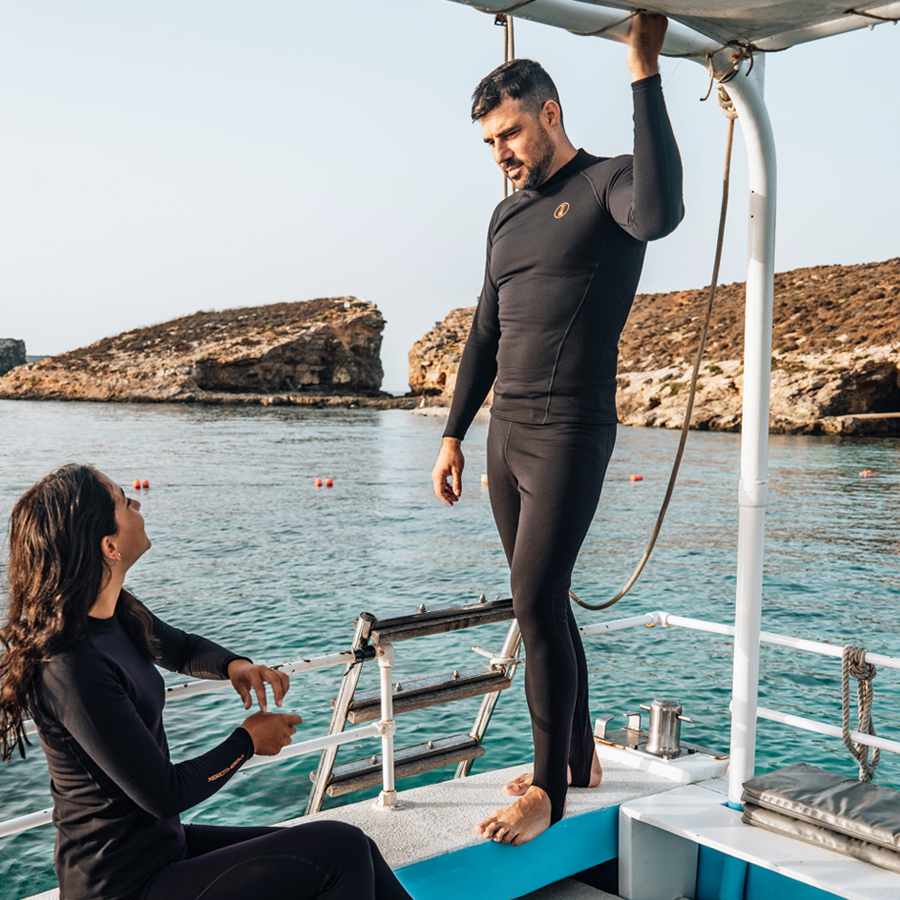
Fourth Element offer two distinct baselayer products, and they're built for slightly different jobs. Understanding the difference will help you choose the right one, or the right combination, for your diving.
J2 Baselayer
The J2 is Fourth Element's super-light, fast-wicking baselayer designed to be worn under any undergarment. It's built with Silver-ion technology, tried and tested anti-microbial silver ions embedded in the fabric, which keeps the garment fresher for longer between washes. This matters more than it sounds; anyone who dives regularly knows how quickly a baselayer can start to smell if it's not treated properly.
Key features of the J2:
- Extremely fast-wicking, designed to draw perspiration away from the skin to keep you warmer
- Lightweight and compact, packs down small for travel
- Silver ion anti-microbial technology to keep skin fresh
- Made with GRS Certified Recycled Polyester as part of Fourth Element's OceanPositive range
The J2 is a true baselayer in the traditional sense: its job is moisture management, not warmth. Think of it as the foundation you build your thermal layers on top of, rather than a layer that will keep you warm on its own in cold water.
See the J2 in Action
Xerotherm
Xerotherm is a step up in versatility. Built using Polartec Powerstretch, a fabric originally developed for NASA, it traps a layer of air next to the skin to keep you warm and comfortable without adding bulk. Unlike the J2, Xerotherm is designed to be worn either as a baselayer or as a standalone thermal layer, depending on conditions.
Key features of Xerotherm:
- Polartec Powerstretch fabric for warmth without bulk
- Fast-wicking, moisture is drawn out through fine fibres and dispersed over the outer surface
- Low bulk and buoyancy, so it doesn't fight your weighting
- Performs even when wet, providing useful warmth even with a small suit leak
- Versatile enough to wear on its own in milder conditions, or layered under a thicker undersuit in colder water
This is the layer most divers reach for when they want genuine warmth and moisture management in one garment, without the bulk of a full undersuit.
So Which One Should You Choose?
It comes down to what job you need the layer to do.
If you're looking for a true next-to-skin layer that manages moisture and works underneath a separate thermal undersuit like the Arctic X, Halo A°R, or X-Core, the J2 is the better choice. It's light, it packs away small, and it does one job extremely well.
If you want a single layer that can provide real warmth on its own, particularly for milder New Zealand conditions or as a mid-layer in colder water, the Xerotherm range is the more versatile option. Many divers also use Xerotherm accessories, such as the socks, gloves, and beanie, to target commonly cold extremities without needing a full extra layer.
For genuinely cold water, the two aren't mutually exclusive. A common and effective setup is a J2 next to the skin for moisture control, with a thermal undersuit on top. For milder days or shoulder-season diving, Xerotherm alone is often enough.
A Quick Word on Fit
A baselayer that's too loose won't wick moisture effectively, since it needs to sit close to the skin to do its job. Too tight and it'll restrict movement and circulation, which works against you in cold water. If you're unsure on sizing, it's worth trying before you buy, particularly if you're between sizes or planning to layer it under other garments.
Global Dive Staff Picks
Andrew: I used Xerotherm as my baselayer of choice for close to 15 years, first under my Arctic, then Halo. But since the J2 was launched, I subconsciously grab that every time. I now treat my Xerotherm as an extra thermal layer to complement the others rather than my baselayer. The J2 gets used on short shallow dives in summer through to long, deep deco dives. It just works great every time!
Anna: I've been using J2 for many years, I love them so much I've bought multiple tops and pants. They are so good I wear them in the shop in winter!!
Dave: J2's are my preference under my Halo or Arctics, I love using them during cave dive trips where my buddies thank me for their superior odour control when worn on multiple days!!
Chloe: I've been very happy with my Xerotherm baselayer. I use it on its own in summer, and in addition to my Arctic in winter. I just don't like being cold, so these combinations work really well for me.
Come Try Them On
Both the J2 and Xerotherm ranges are in stock at Global Dive, and we're always happy to talk through your specific diving conditions and help you land on the right combination. If you're upgrading your undersuit setup or just starting out in a drysuit, come in and chat with the team.
This post draws on layering guidance from Fourth Element.
