
Wildlife of the Month - Green Lipped Mussels
Anna Clague Jan 29, 2025
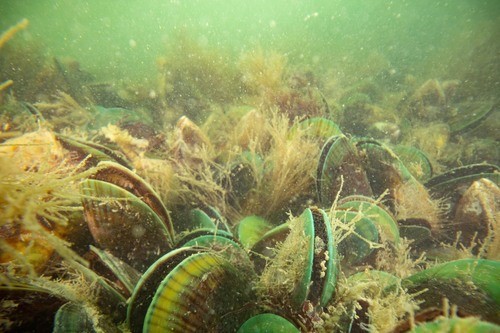
Perna canaliculus
Habitat - P. canaliculus is endemic to New Zealand. Found all around the NZ coast but most common in central to northern parts. Dense beds are found from intertidal to 50m on moderate to exposed shore.
Feeding - They are a filter feeder, feeding on various types of phytoplankton
Size - It is one of the largest mussel species, growing to over 240mm in shell length.
Breeding Habits - The green-lipped mussel is a dioecious (uni-sexual) broadcast spawner. Gonadal development takes place at temperatures above 11ºC and is also related to food availability. Most spawning occurs from November to April, but larvae can be present all year. Sexual maturity is reached in the first year by 40mm shell length, and females can produce up to 100 million eggs per season. The planktonic stage is ready to settle after a three to five week larval phase. The larvae swim only vertically but they can be transported large distances by currents and tides. In the wild, larvae settle over a wide range of depths. Juvenile mussels may move numerous times before settling on adult mussel beds. There is little information on age, growth and natural mortality, particularly for wild populations.
Defense - It often has symbiotic pea crabs living inside and a hydroid called mussels beard (Amphisbetia minima) attached to the outside.
Description - This shellfish is economically important to New Zealand. It differs from other mussel species in that it has dark brown/green shells with green lips around the edges, and has only one adductor muscle. Often the surface of the shell is overgrown by other encrusting animals.
