
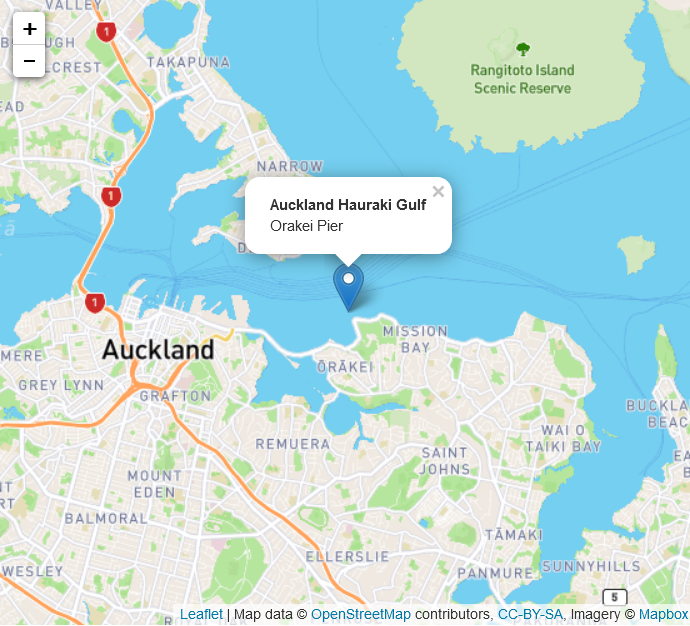
Auckland Hauraki Gulf Orakei Pier
DESCRIPTION
By Simon Collins (with buddies Jan Haynes and Jamie-Lee Thorpe)
Shore diving in Auckland normally means a drive up to Leigh, but we decided to try somewhere a little closer to the city. I have spent a few evenings fishing off the Orakei Pier, just by Kelly Tarlton’s Sea Life Aquarium and have caught small snapper, a small shark, lots of Cushion Stars and no dinner. I have also seen Short Tailed Stingrays and Eagle Rays landed there, so why not dive there?
Knowing that it’s a popular fishing location be sure you dive safely if in close proximity to the anglers. Be seen by them whilst you are under the water – we achieved this by towing a dive flag and float buoy attached to a rope during the dive and talking to the anglers before we entered the water, which was very easy as they were all intrigued by our activities.
We planned to enter the water using the stairs at the end of the pier, descend and swim back towards the shore, visiting each pylon that supports the pier. We went at slack high tide as we knew the location was shallow and has low visibility.
After unloading the car and parking it on Tamaki Drive, we geared up to the amusement of the cyclists, walkers and one wedding party then walked along to the end of the pier. We were fortunate as all the anglers were on the end of the pier and not along its length where we had planned to dive. We carefully descended the slippery stairway into the water under the curious gaze of the anglers. We allowed the dive flag some rope and began our descent. We found the bottom by feel just below 5 meters as the visibility was less than a meter. Each pylon leg was encrusted with shells and the floor was covered in mussels.fanworm We had to refer to our compasses to locate the next pylon, again due to the visibility. Sea Stars, Coscinasterias calamaria and Cushion Stars were in abundance and for each Sea Star, there would have been at least 3 gobies, perched on top. Amongst the mussels were scattered the invasive, but pretty species of Mediterranean Fan worms, nudibranchSabella Spallanzanii that have been introduced into New Zealand waters in the ballast of international shipping. Another foreign species that we found was a colourful Filipino nudibranch, Thecacera pennigera. We had hoped to find sea horses, but this was not to happen on the two dives we made, however we were lucky enough to find a small Pipe fish instead. We had heard that Star Gazers can be found in the area too.
Apart from the mussel shells to be cautious of on the bottom, there were of course hazards left from the anglers, hooks, line, knives, scissors and plastic. For our exits, we used the stairs where we had entered for one of the dives and for the other we swam back to the road side and exited up the stairs right next to the car. This, for future reference, although it seemed a good idea as it would mean not carrying our equipment as far, was actually rather difficult due to the rocks and shells that were now making our exit to the stairs difficult once the water level began to drop.
We have only dived along one side of the jetty so hope to return to dive along the other side soon. Also we would be interested in diving along the wooden pylons that make the harbour barrier on the city side of the pier. But due to boat traffic, we will do from a boat or kayaks.
